Organized by grade: Kindergarten, Grade 1, Grade 4/5, Grade 5/6, and Grade 9
Kindergarten Math
Race to the Top!
Date: April 2024
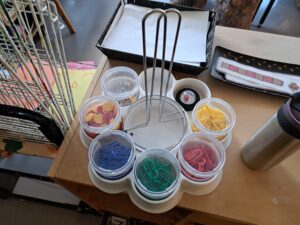
Description: Students play a game of “Race to the Top” using links, a paper towel holder, and a die. The game works by each player choosing a colour of link (e.g., player 1 is read and player 2 is blue). Then each player rolls the die and adds that number of links to the paper towel holder. For example, if a player rolls a 5, then they add 5 links. Whoever gets to the top first, wins.
Curriculum connection:
- Overall Expectation DM1 – Demonstrate an understanding of numbers, using concrete materials to explore and investigate counting, quantity, and number relationships.
- Overall Expectation PS1 – Apply the processes of mathematical thinking, including reasoning, reflecting, and problem-solving, in different contexts.
Picture:
Counting Grape Caterpillars
Date: April 2024
Description: To build on the students’ natural curiosity about bugs, we integrated math and creativity by making “grape caterpillars” and “celery logs.” Students used grapes to measure the length of celery sticks, exploring non-standard units of measurement in a fun and engaging way. This playful hands-on activity encouraged observation, counting, estimation, and comparison, all while connecting to the class’s interest in insects and outdoor discoveries.
Curriculum Connection:
This activity supports the Kindergarten Program in the following areas:
- Problem Solving and Innovating: Students estimated and measured length using real-life materials, developing foundational numeracy skills through exploration.
- Demonstrating Literacy and Mathematics Behaviours: The use of non-standard measurement tools (grapes) helped students practice counting, comparing lengths, and using mathematical language (e.g., longer, shorter, more, fewer).
- Demonstrating Knowledge of the World: By engaging with natural themes (insects and plants), students made connections between the environment and mathematical concepts.
- Belonging and Contributing: The activity fostered collaboration and conversation, allowing students to share their ideas and observations in a playful, meaningful context.
This experience demonstrates how math can come alive when linked to students’ interests — turning a fascination with bugs into a joyful, integrated learning moment.
Photos:


Grade 1 Math
Curriculum Connection: C3
Date: December 2023
Description: Fisher-Price ® Think & Learn Code-a-pillar ™ and Twister Coding
Fisher-Price ® Think & Learn Code-a-pillar ™
Materials needed: Code-a-pillar, batteries.
- Works as an excellent “hook”.
- Students use the Code-a-Pillar to learn how code is sequential; it involves a series of steps.
- Students learn to read the Code-a-Pillar code in a sequential order. Students begin to predict how changes to the code will change the outcome.
Twister Coding
Materials needed: Arrows on Q-cards, 2 objects (e.g., stuffed animal mouse and cheese), Twister game mat.
- Students give instructions to get object 1 to object 2 on the Twister board.
- Students practise their directions (e.g., left, right, up, down).
- Students must use simple instructions that a computer would understand (e.g., “move 2 spaces up”).
- Students learn about efficient and inefficient pathways, and when someone might choose to take a more, or less, efficient path (e.g., when someone really has to get home to use the washroom, they might want to take an efficient path. When someone wants to take their time, and smell the flowers along the way, they might take a more inefficient path).
Grade 4/5 Math
Subject: Math, Data Literacy (D1.3)
Date: March 2023
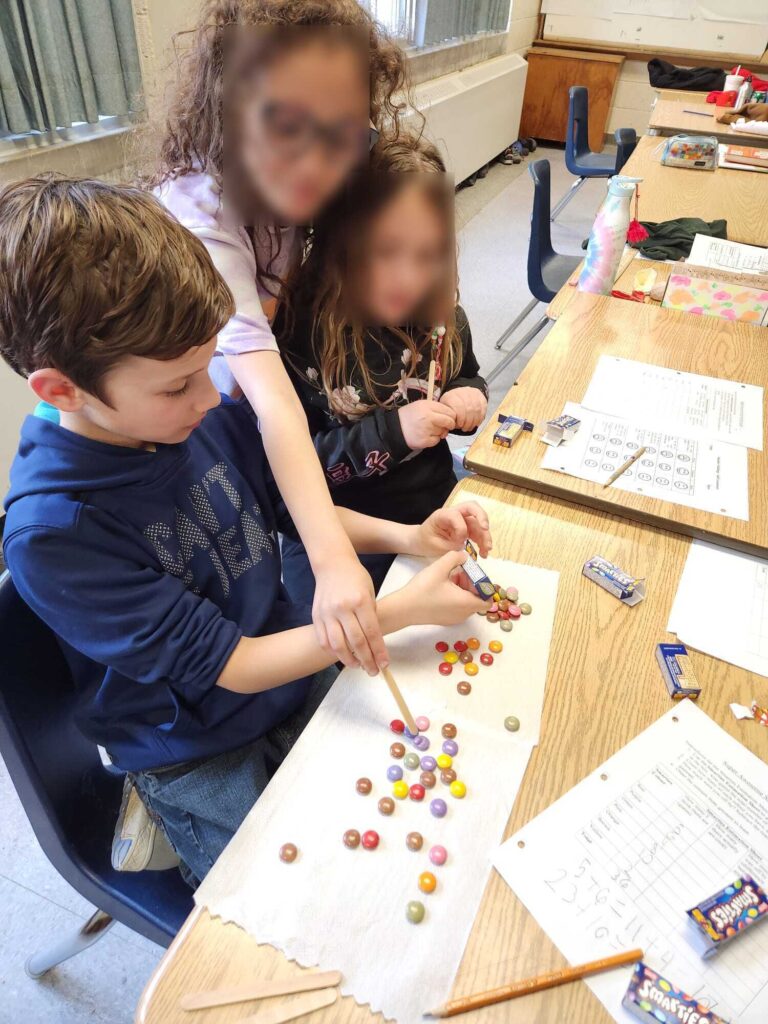
Description: Making predictions and graphing with Smarties.
Power Point:
Super-Fun-Lesson-Using-Pictographs-and-SmartiesDownload
Pictures:
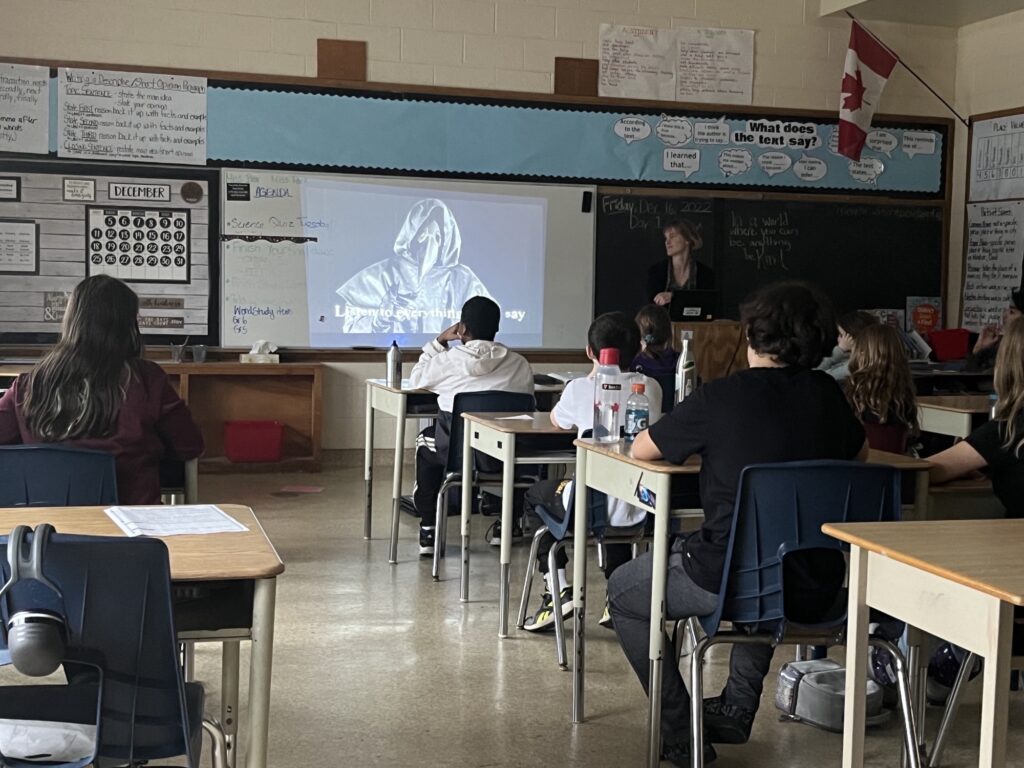
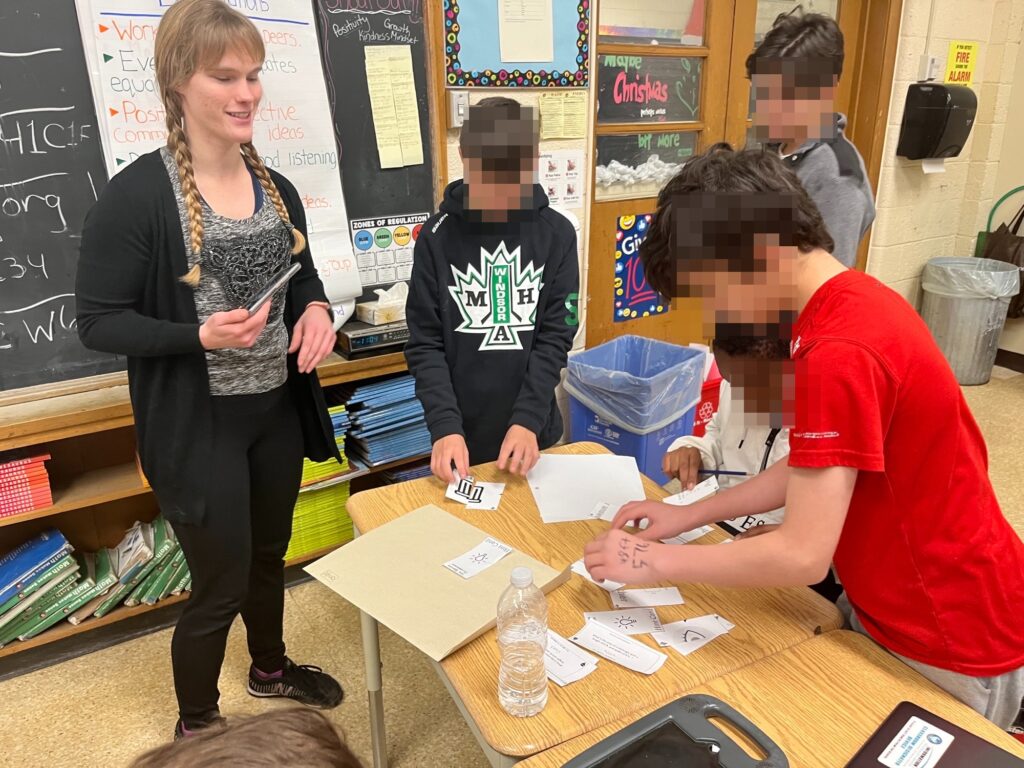
Grade 5/6 Math
Subject: Math, Measurement (E2)
Date: December 2022
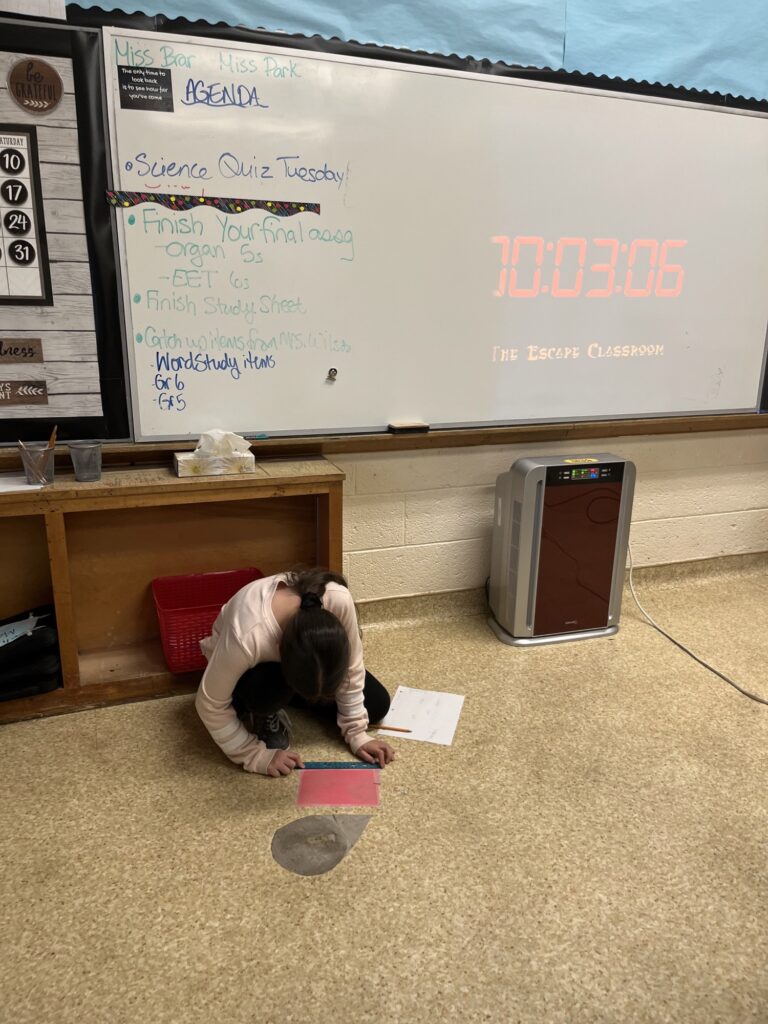
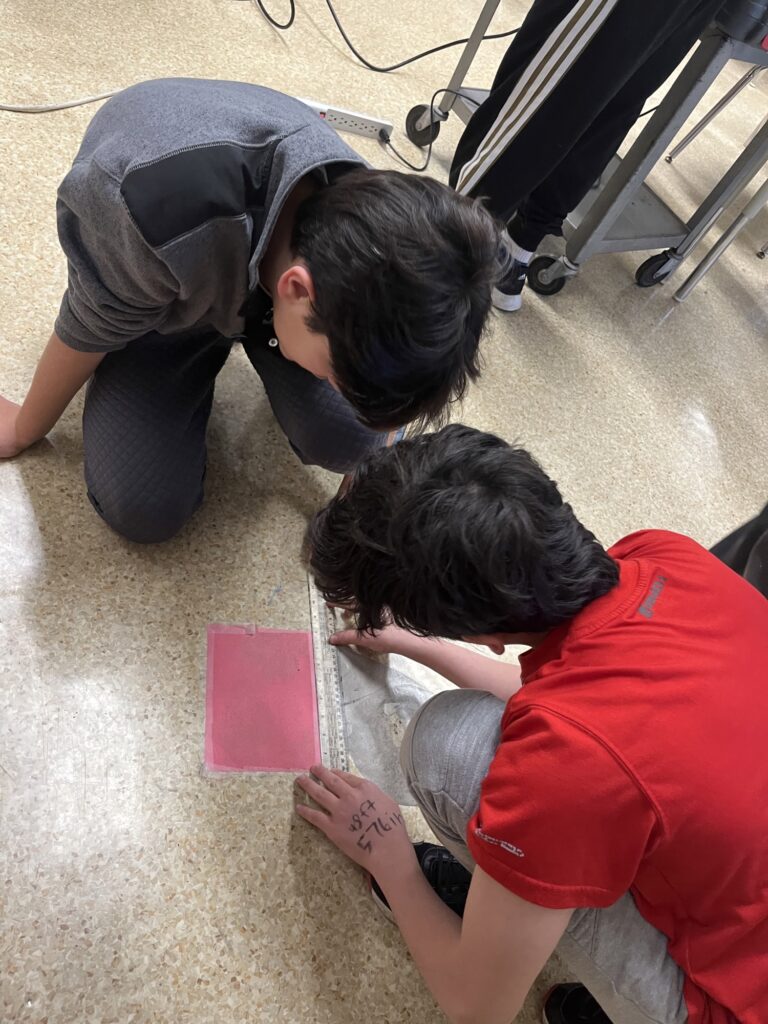
Description: Escape room based on finding the area and perimeter of rectangles.
Pictures:
Grade 9 Math
Similar Triangles, Ratios, and Indirect Measurement
Date: 2024-2025
Description: In this hands-on geometry project, students used indirect measurement to estimate the height of tall objects (e.g., flagpoles or walls) they couldn’t measure directly. Depending on the weather, students completed either an outdoor shadow-based investigation using similar triangles or an indoor version using a string, ruler, and proportional reasoning. Working in pairs, students took real-world measurements, calculated unknown heights, and analyzed sources of error to develop critical thinking and spatial reasoning skills.
Curriculum Connection:
- E1.2 – Solve problems involving the application of the Pythagorean relationship and the properties of similar triangles.
- E2.2 – Determine, through investigation using a variety of tools and strategies, the relationships between the lengths of corresponding sides of similar triangles.
Document: